
Originally featured in The Founder Newspaper, November 2020
In terms of production quality, the sky’s the limit when it comes to Translations. Quite literally.
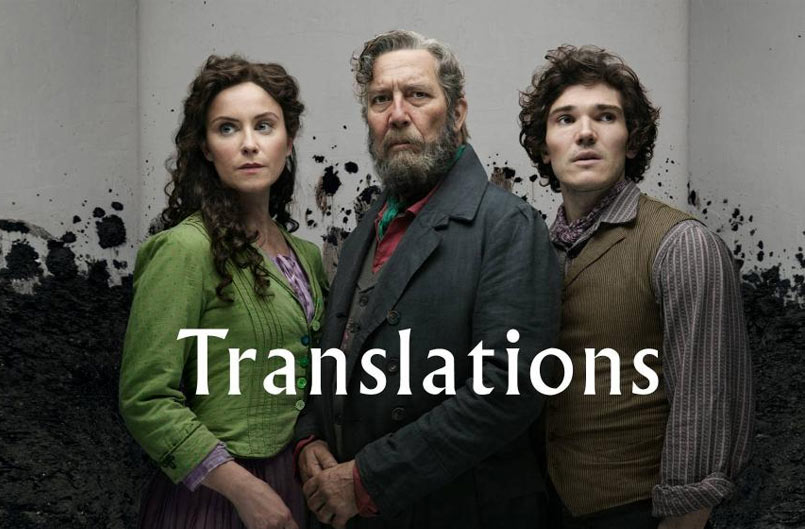
The play Translations opens with a sunset. Such a vivid one in fact that the silk screens which make up the play’s backdrop appear to be on fire. It’s an astonishing achievement by lighting designer Neil Austin: a combination of thin silks and smoke which when hit with lights swirl as clouds or burn as embers or bucket rain as needed. When teamed with the muddy heath which surrounds the stage, water pooling and plants growing in rough shodden tufts, it’s easier to see why Brian Friel wrote a play about the legal status of Irish land.
Prodigal son Owen returns to his father’s hedge school a hero; a successful businessman with six servants and nine shops who has overcome his humble beginnings to rise high. It’s a genuine, warm reunion, so his father agrees immediately when asked if two new friends can join them. The air chills when they are all introduced to two British soldiers, work ‘friends’ whom Owen is translating for, and neither party can understand the other’s tongue.
The anglicisation of the Gaelic names of towns in Ireland is not the most interesting of topics at first glance, I’ll admit. Nor does it seem a particularly charged subject in the days of Google Translate. Its importance becomes unsettlingly apparent, however, as the real reason for the British presence in Ireland is revealed. As well as ‘standardising’ its town names, the soldiers are there to accurately map Ireland’s geography for military purposes, and to increase land tax by measuring how much land is used for agriculture. The secondary purpose of their visit is yet more insidious; to open a state school for the local children.
Forced to attend, children aged between six and twelve would be away from the fields at harvest, learning and communicating in only English for hours a day to replace their mother tongue, a tactic which was also used upon indigenous children in Canada until an astonishing twenty three years ago. Translations is both an ode to the death of the Irish language and a play which explores the role that language plays in forming identities both personal and cultural.
Do not, however, confuse this ode for a dirge. It’s only a bleakly moving play in its aftermath, and before that laugh-out-loud funny at points, from the awkwardness of the Captain’s exaggerated hand gestures to the touchingly funny attempts at communication from lovers Lieutenant Rolland and Maire, or Owen, willingly going by ‘Roland’ because his British colleagues can’t pronounce his name.
This National Theatre production is an ecosystem. There’s a climate of rain and mud and earth. The Irish half of the cast blend in perfectly with their fertile landscape, the vivid scarlet of Royal Marine coats marks them out as a dangerous invasive species. Most strikingly, the world which makes up this production of Translations bursts with life, so to Ian Rickson and co, bravo.
Leave a Reply