
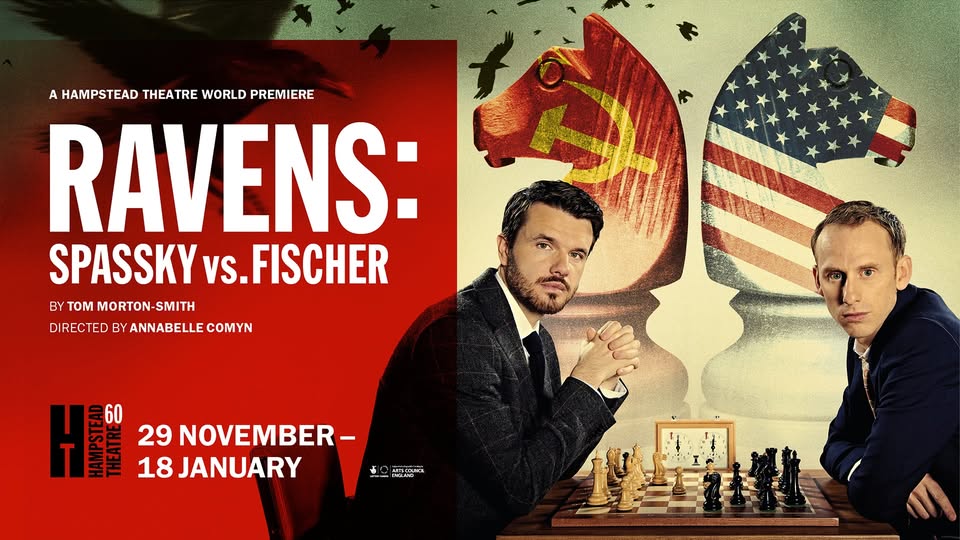
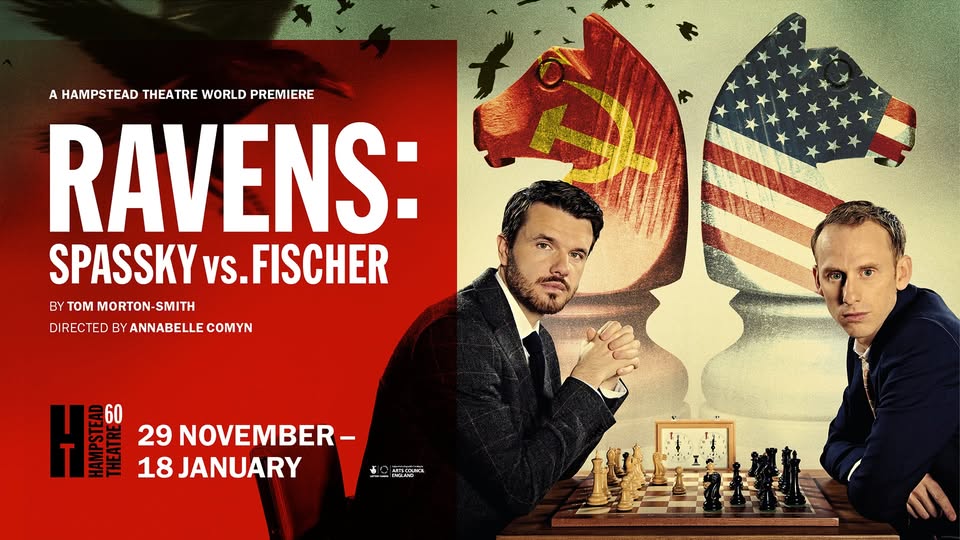
For a play about a Cold War chess tournament, Tom Morton-Smith’s Ravens: Spassky Vs Fischer is an unexpectedly heated one.
From Ronan Raftery’s initially reserved Spassky bellowing a victory song in Russian to Fischer’s persistent fits of shouting, the psychological effects of representing two warring countries on the world stage grow louder and louder throughout the course of the play until by the end both begin to sound like cries for help. The fear of surveillance embodied by faceless shadows behind a screen in Spassky’s case and phone calls from Henry Kissinger in Fischer’s is a further similarity which connects two characters initially as opposed as the board’s squares. It also does a great deal to humanise Fischer: a character who would verge on unbearable without it.
Bobby Fischer truly is the child Spassky accuses him of being, a brat prone to spiteful and vicious outbursts ranging from throwing his chess set at his second in command to spitting on a Chess Federation official. The astonishing lack of self-awareness Robert Emms imbues Fischer with, however, eventually becomes pathetic enough to earn him an amount of sympathy, though his anti-Semitic remarks are inexcusable. Stripped down to a vest and gloating to his mother about how his is a brain any psychiatrist would be honoured to study, his bad behaviour is revealed to be a symptom of something far more sinister as she examines his mouth. Fischer’s paranoia has led to him having every filling in his mouth removed for fears of mind control and his triumphant monologue about being a God comes out resembling more of a nervous breakdown – the audience watches a child screeching and teetering dangerously on the edge of a hotel desk as helplessly as his mother does and is forced to an uncomfortable sympathy by the end.
Morton-Smith makes a further brilliant choice with the Russian team’s stage directions and has them speak in heavy accents only around the Western officials, slipping into regional accents when alone. The decision to use the actors’ differing native accents both reveals the artificiality of the controlled front required by the USSR and presents the Soviets as individuals, Estonians and Ukrainians with differing opinions on the Communist Party behind closed doors. Spassky’s faultless public manners mask a deep dissatisfaction with the misuse of resources in Russia and the extent of the KGB’s reach, a stance which makes his teammate Iivo’s forced return to Russia being for fears of desertion all the more upsetting.
Spassky shares none of Fischer’s blood lust when it comes to chess. He appreciates the beauty of the game so much he applauds his own defeat and admits he has used it as a coping mechanism since a young age. His worry that Fischer does not ‘even know what he represents… what this represents’, however, is unfounded. Both brilliant men are aware of the Cold War, the role they play in unwillingly embodying Russia versus America and Capitalism versus Communism. Both know that the singular camera arranged over their heads is broadcast to a waiting world and that every move they make has consequences on the World Stage. Both, most importantly, are excruciatingly aware of their own role as nothing but political pawns.
Leave a Reply