
This review was originally created as part of Lesflicks.com‘s coverage of Wicked Queer | Boston’s LGBTQ+ Film Festival 2022.
Firstly, a trigger warning. This film displays the aftermath of a suicide, and contains homophobic remarks.
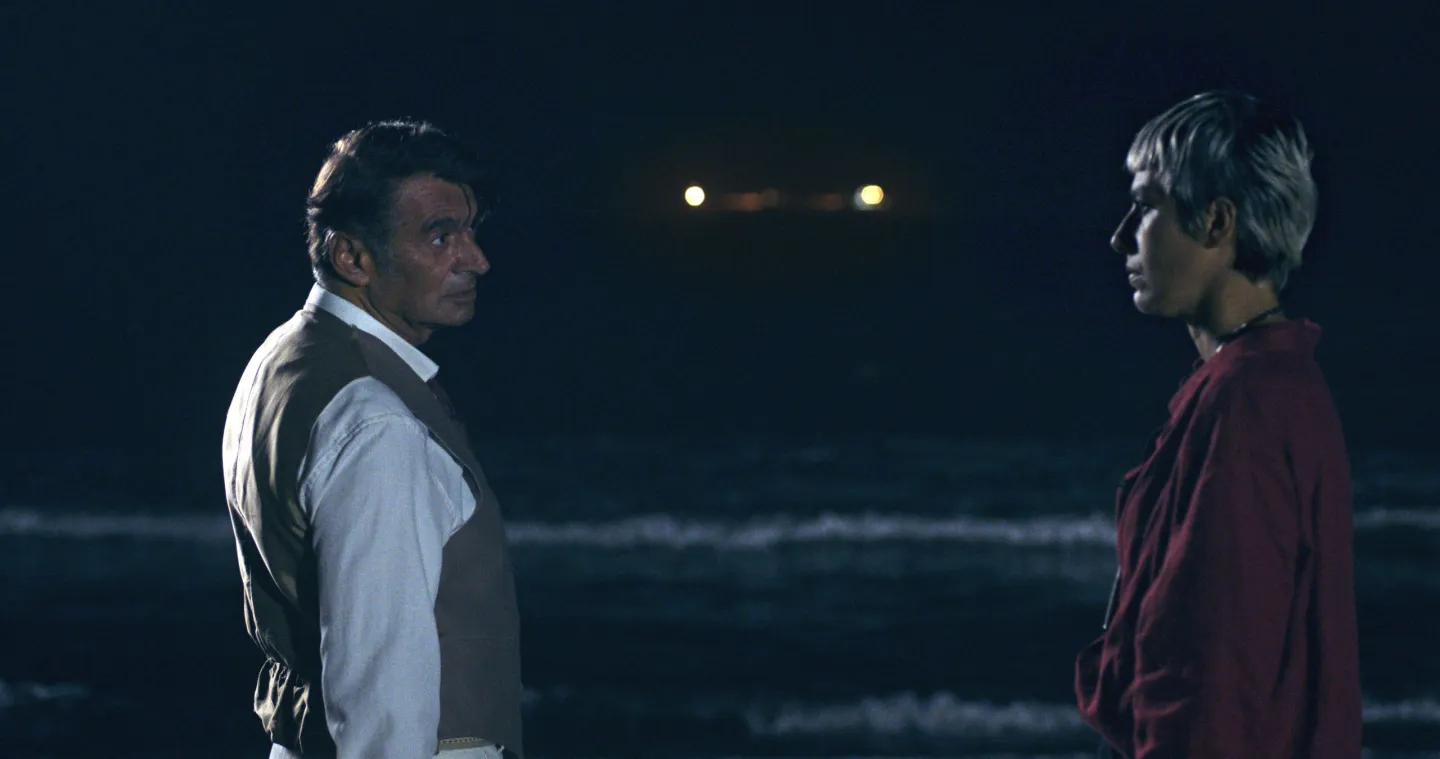
There are only so many ways you can use a shot of the sea in a film. If it’s not symbolising the character feeling adrift in their personal life, it’s passing the time or separating two lovers, a symbol of the unfathomable nature of existence since Homer. It’s beautiful. It’s an easy metaphor. The sea’s a shortcut to getting your point across. I’ve never been startled by a use of it before. The shot of the sea at Elene Naveriani uses in the film’s opening minute is wrong, somehow, forgoing the beach entirely and forcing the viewer to peer out into the moonless darkness. The waves are too evenly spaced and too many, with huge clouds taking up the sky as well as the majority of the frame. A man made entirely of shadow. A neon light made to appear dull on screen. These visual clues create a sense of dread even before ‘Our Love Lies’ by Swans plays over the same man meticulously preparing a suicide note.
It’s a grim opening, and not the only upsetting incident to occur during the film’s runtime. Hatred for others being barely concealed beneath claims of ‘civility’ and ‘belief’ remains an upsettingly relevant topic in 2022, and the dehumanising treatment of Eliko’s body after his death is agonising to watch at times.
Given my two-paragraph warning about such dark themes, my urgent plea for you to watch this film if it is showing anywhere near you – or drive to it if it isn’t – must seem rather misguided. Urgent, however, is exactly the word to describe Elene Naveriani’s work. Wet Sand (2021) is a searingly honest, deeply human reminder of love in Eastern Europe, and the societal challenges LGBT citizens who long for it face.
It is a remarkable film – perhaps due to the many contradictions I find in describing it. In parts, working alongside rather than contradicting the brutality warned of above, it is the gentlest film I have watched all film season. A lesbian bonds with her grandfather’s partner of twenty years, lying comfortably on her bed as he relays the lives they shared together. Hands touch and brush and cling, movements hidden from the residents of the outside world which emphasise the oppressed kinship of the protagonists to the reader. Even the mistreatment of Eliko after death is counteracted in an intensely intimate manner, a hidden apology I teared up whilst watching. No such touches are shared by the ‘civilised people’ who coexist beside our queer protagonists, and watching the tactile Amnon (Gia Agumava) hide the physical signs of his grief to ensure his place amongst them emphasises the masks which must be adopted for safety’s sake. Traditional ideas of masculinity and femininity. Traditional ideals of sexuality. Traditional ideals of morality. It’s amazing to watch the cracks in this iron grip appear.
Moving. Heartbreaking. Unsettling. Affirming. It’s a ferocious piece of cinema with beautiful cinematography and a soundtrack that haunts.
Leave a Reply